Annapurna vs Everest Base Camp: Which Trek Should You Do First?
Most people who ask this question have been researching for a while and found conflicting answers. Operators say both are perfect for beginners. Travel blogs rate one higher than the other depending on who wrote the article. And somewhere in the results, someone's favourite trek appears as definitively better.
The honest answer is narrower than that: it depends on what you haven't done yet, and how much altitude you've been at before.
The Number That Actually Matters
Annapurna Base Camp sits at 4,130 metres. Everest Base Camp sits at 5,364 metres. That gap of more than 1,200 metres is not just a number on an itinerary. At Everest Base Camp, the air contains roughly half the oxygen available at sea level. The physical experience of walking in thin air at that altitude is different in kind, not just in degree, from trekking at 4,000 metres.
Acute mountain sickness (AMS) affects people regardless of fitness level. Athletes who have raced long distances have been evacuated from EBC. People with no particular athletic background have reached the top without a headache. There is no reliable relationship between how fit you are at sea level and how your body responds to altitude.
Annapurna Base Camp has altitude risk, but the profile is shorter and lower. One Nepal-based trekking operator describes the Annapurna region as providing 'a safer first introduction to Himalayan altitude, with a more favorable acclimatisation pattern' compared to EBC. For a first-time high-altitude trekker, this difference matters more than almost anything else.
The Logistics Question
Getting to the Annapurna Base Camp trailhead involves a drive from Pokhara. No domestic flight required. If anything delays the start, you adjust and continue.
Getting to the Everest trek requires a flight into Lukla airport at 2,860 metres above sea level. Lukla flights are weather-dependent. During peak seasons, flights frequently operate not from Kathmandu but from Ramechap airport, 4.5 hours away, with departures as early as 2am from the city. Cancellations happen. If you're working with a fixed return date, a Lukla delay doesn't just affect Day 1. It compresses everything that follows.
The Annapurna approach removes this variable entirely.
What You're Actually Walking Through
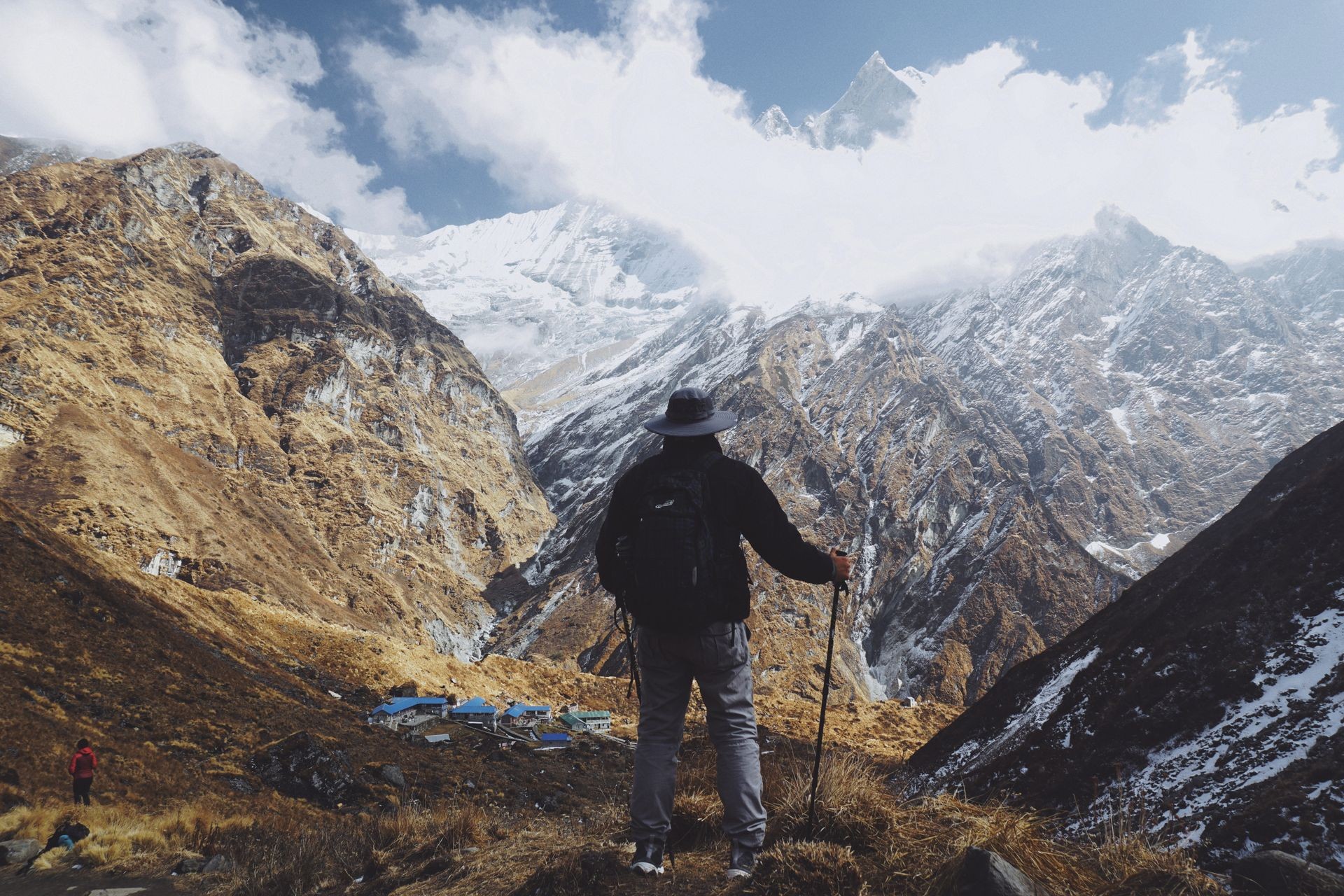
Annapurna and Everest offer two different types of Himalayan landscape. The Annapurna approach moves through subtropical forests, rice terraces, traditional Gurung and Magar villages, rhododendron and bamboo zones, and eventually the Annapurna Sanctuary: a circular amphitheatre of peaks above 6,000 metres. One first-time trekker described entering the sanctuary as 'the most incredible experience ever,' arriving after days of varied terrain to find herself surrounded by 11 peaks in a ring.
The Everest trail is more consistent in character from early on. Sherpa villages, Buddhist monasteries, glacial moraine, and a steady visual accumulation of high peaks. You're walking toward one specific thing, and the landscape knows it. The first glimpse of Everest from the resting platform after the Hillary Suspension Bridge is a moment trekkers consistently remember. Many describe it as the point where the trek became real.
Neither landscape is objectively better. Trekkers who want variety, cultural texture, and greener terrain tend to find Annapurna more satisfying. Trekkers who want the singular pull of Everest, who've thought about it for years, often find Annapurna feels like a detour from what they actually came for.
Crowds
Everest Base Camp is the more globally famous route, and the trail reflects it. Peak season on EBC has been described by independent trekkers as 'zoo-like, with insane numbers of trekkers, guides, and donkeys.' Even in December, one solo trekker described EBC as having 'more people than I've ever seen in the Karakoram, where I usually trek.' Manageable, but busy.
Annapurna receives fewer trekkers in absolute numbers. Specific sections, particularly around Poon Hill, can be busy in peak season. But with route flexibility and a good operator, quieter stretches exist. One industry breakdown puts it clearly: Annapurna is suited for 'first timers, families, 50+, culture seekers.' EBC is suited for 'icon seekers, photographers, return trekkers.'
Duration and What It Means
Annapurna Base Camp: 7 to 10 days, starting from Pokhara. Everest Base Camp: 12 to 14 days minimum with a responsible acclimatization schedule.
The 12 to 14 day EBC figure is not padded. It reflects what proper acclimatization actually requires. Trekkers who book 10-day EBC itineraries are assuming nothing goes wrong at altitude. Something usually does. Rushing Everest is one of the most consistent reasons first-timers turn back early.
The Recommendation
If this is your first high-altitude trek and you haven't trekked above 3,000 to 3,500 metres before: Annapurna Base Camp is the better starting point. Lower maximum altitude, no flight dependency, shorter trip, and a route that delivers a complete Himalayan experience rather than a single summit objective.
If you've trekked at altitude before, have 13 to 14 days without a fixed deadline, and Everest is specifically what you came for: EBC is achievable with the right operator and the right pace.
The difference between a successful EBC attempt and a failed one is almost never fitness. It's almost always pace. Highlander Nepal has been running treks in both regions for over 35 years. If you want to talk through which route fits your fitness level, timeline, and altitude history before committing, that conversation costs nothing.

-
PO Box: 10987
Thamel, Kathmandu -
+977-01-4700563, +977-01-4700066
Whatsapp: +977 9851167070

